
Plug it in at 8:00.
Tracking by 8:15.
It clicks into the OBD port and starts reporting. No wiring, no tools, and no vehicle out of service.
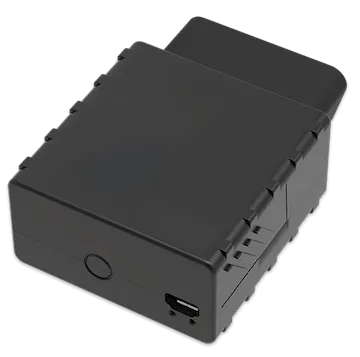
The install is you, in a car park, for a few minutes.
Find the OBD port, click it in, and the vehicle appears on the map. Move it between vehicles whenever your fleet changes shape.
- No wiring, no tools, no installer appointment
- Reassign a unit to another vehicle by calling Client Care
- Locking connector on selected variants
More than a dot on a map.
Because it sits on the OBD port, IQ-Plug reads what the vehicle already knows: fault codes, engine data, and the driving itself.
- Standard OBD-II codes plus manufacturer-specific codes
- Built-in accelerometer for driver behavior and crash detection
- Wireless firmware updates, so the device improves in place
Tracking on the whole fleet by the end of the day.
The specs are further down. This is what they mean once it is in the truck.
You can see where a truck is without calling the driver
About 2 m accuracy in open sky, and the position refreshes four times a second while it moves.
You can fit the whole fleet yourself
It clicks into the OBD port. No wiring, no tools, no installer, and it moves to another vehicle when you need it to.
You hear about a fault before it becomes a breakdown
It reads the vehicle's own fault codes, standard and manufacturer-specific, plus harsh driving and crash detection.
You can see which trucks burn fuel standing still
Engine-on, wheels-stopped time is logged per vehicle, so idling stops being a rumor and turns into a number you can take to the driver.
Service comes due on what the vehicle actually did
Reminders run on the odometer and engine hours read straight off the OBD port, instead of a spreadsheet someone updates when they remember.
You find out the truck left the yard at 2 a.m.
Draw a geofence around the yard and after-hours movement pushes an alert to your phone. Live position is what turns a stolen-vehicle report into a recovery.
IQ-Plug, in full.
Positioning
- Constellations
- GPS, GLONASS, BeiDou, Galileo and QZSS depending on variant
- Augmentation
- SBAS: WAAS, EGNOS, MSAS, GAGAN
- Accuracy
- Approximately 2.0 m CEP, open sky
- Update rate
- Up to 4 Hz
- Time to first fix
- Hot start from 1.8 s, cold start from 11.5 s with assistance enabled
- Sensitivity
- Tracking to -167 dBm, acquisition to -148 dBm cold start
Connectivity
- Network
- LTE Cat 1 and Cat M1, with 3G and GSM fallback depending on variant
- Data
- Up to 375 kbps down and up on Cat M1
- Short range
- Bluetooth on selected variants
- Updates
- Wireless firmware updates
Vehicle data
- Connector
- OBD-II, with J1939 and CAN on selected variants
- Protocols
- J1850 PWM, J1850 VPW, ISO 9141-2, ISO 14230 KWP2000, SW-CAN, ISO 15765 CAN
- Codes
- Standard OBD-II codes plus manufacturer-specific codes exposed by the vehicle
- Motion
- Built-in accelerometer for driver behavior and crash detection
Power
- Operating voltage
- 8V to 32V DC, vehicle dependent
- Consumption
- About 2 mA deep sleep, about 30 to 40 mA actively tracking at 12V
- Backup battery
- 180 to 300 mAh lithium-ion, variant dependent
Physical
- Dimensions
- From 46 x 67 x 28 mm, variant dependent
- Weight
- From 50 g
- Operating temperature
- -10°C to +60°C
- Storage temperature
- -40°C to +85°C
- Humidity
- 90% non-condensing
Figures span the IQ-Plug family. Your quote confirms which variant suits your vehicles.
All specifications are typical and subject to change without notice.
Solution sheet
One page, no form. Forward it to whoever signs off on the fleet budget.
Asked about IQ-Plug.
Can I install IQ-Plug myself?
Will it drain my battery?
What does it actually report?
Can I move it between vehicles?
Is there a contract?
Put IQ-Plug in one vehicle this week.
Fifteen minutes to install, and you'll see the live map, the trips, and the diagnostics for yourself. No contract either way.
Prefer to talk? 1-888-606-6444